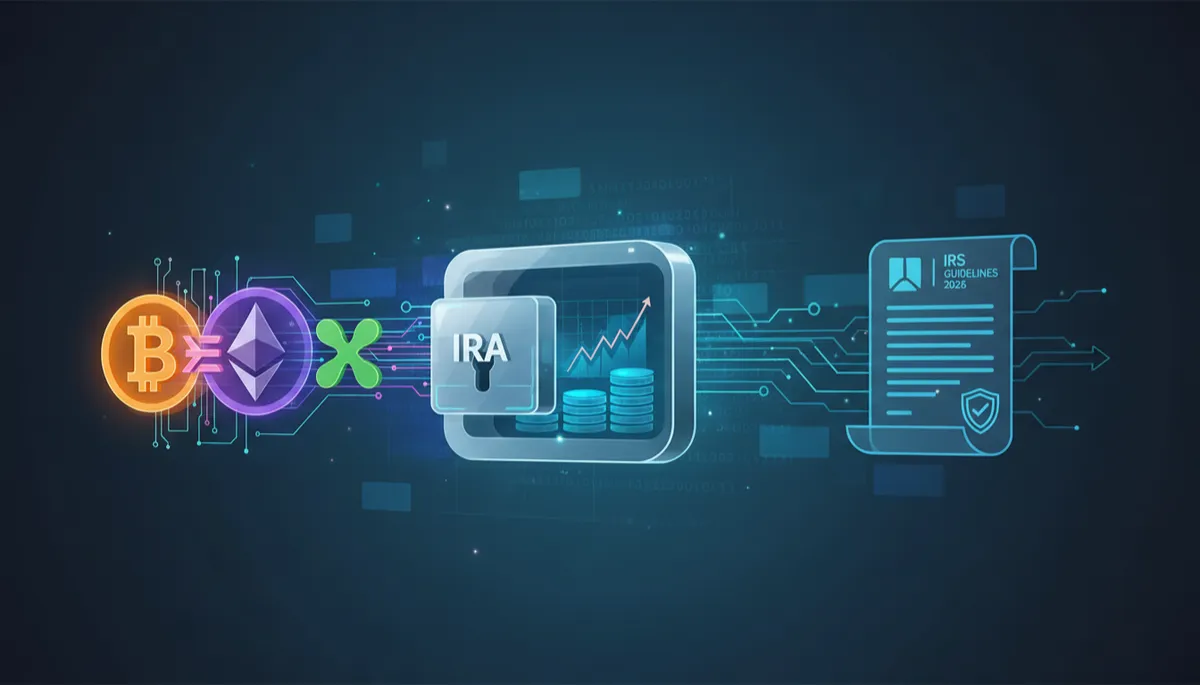
Guide to Crypto SDIRAs: Bitcoin, Ethereum, XRP
Crypto & Digital Assets
Bitcoin, Ethereum, and XRP in Your IRA: The Complete 2026 Guide to Crypto SDIRAs
The IRS now treats digital assets as property, not currency, which means cryptocurrencies like Bitcoin, Ethereum, and XRP can be held in properly structured self-directed IRAs (SDIRAs). In 2026, with new reporting rules and evolving broker obligations, it is more important than ever for self-directed investors to understand how crypto fits inside a retirement account, how Form 1099-DA works, and what to look for in a custodian before moving funds.

1. How the IRS Treats Crypto as Property in 2026
For tax purposes, the IRS categorizes Bitcoin, Ethereum, XRP, stablecoins, and most other cryptocurrencies as digital assets and, critically, as property rather than currency. This classification, reflected in current IRS guidance on digital assets, places crypto in the same broad tax bucket as stocks or real estate when it comes to gains and losses, even though the underlying technology is very different (see IRS digital asset filing guidance on irs.gov).
For a self-directed IRA investor, this is good news. Because crypto is treated as property and not as a collectible, it does not fall under the immediate-taxation rules that apply to collectibles under Internal Revenue Code section 408(m). The IRS has published guidance on collectibles in retirement plans that specifically warns that investments in art, antiques, and similar items are treated as taxable distributions when purchased inside an IRA. By contrast, there is no IRS rule that classifies cryptocurrency as a collectible, so purchasing Bitcoin or Ethereum in an SDIRA does not, by itself, trigger a taxable distribution (see IRS Publication 590 and collectibles guidance on irs.gov).
The usual IRA tax advantages still apply. In a traditional SDIRA, gains from crypto trading are tax-deferred until distribution. In a Roth SDIRA, qualified distributions are generally tax-free. The key is that all transactions must occur inside the IRA, through an approved custodian, and without prohibited self-dealing or personal use of the assets, as outlined in IRS Publication 590-B on prohibited transactions.
2. Form 1099-DA: What Crypto SDIRA Investors Need to Know
Beginning with transactions after 2025, brokers handling digital assets must use Form 1099-DA, Digital Asset Proceeds From Broker Transactions, to report crypto sales and certain other dispositions to both the IRS and account holders. Publication 1099 and the Form 1099-DA instructions confirm that for tax year 2026, these forms are generally due to recipients by February 15, 2027, and to the IRS by February 28, 2027 (see irs.gov guidance on Form 1099-DA and Publication 1099).
For self-directed IRA investors, there are two important angles to understand. First, broker reporting does not change the fundamental tax treatment of the IRA. Trades executed inside your SDIRA are still sheltered from current taxation; gains and losses are recognized at the account level and affect your IRA value, not your current-year taxable income. You should not be reporting capital gains from your IRA’s crypto trades on Schedule D, even if a broker issues informational statements. Taxation occurs when you take distributions from the IRA, subject to the usual traditional or Roth rules.
Second, Form 1099-DA obligations primarily fall on the broker or custodian, not on you as the IRA owner. The form requires reporting of gross proceeds and, for covered digital asset securities, cost basis and gain or loss figures. While the IRS has granted transitional relief to brokers through 2026 if they act in good faith, the direction of travel is clear: more detailed, standardized reporting of digital asset activity (see IRS instructions for Form 1099-DA and related bulletins). As a self-directed investor, you should confirm that your crypto IRA custodian understands these requirements and has systems in place to comply, even if the reporting is primarily informational in the context of a tax-advantaged account.
“Form 1099-DA does not make your IRA trades taxable today—but it does increase the visibility of how your custodian tracks and reports digital asset activity.”
3. Choosing a Crypto SDIRA Custodian in 2026
The IRS requires that IRA assets, including those in a self-directed structure, be held by an approved custodian—typically a bank, trust company, credit union, or another institution that meets regulatory standards (see IRS Publication 590-A). With crypto, this requirement is especially important because self-custody (for example, holding IRA assets in a personal wallet you control) can raise serious prohibited transaction concerns and potentially disqualify the entire IRA.
When evaluating custodians for Bitcoin, Ethereum, XRP, and other digital assets in 2026, consider the following factors:
- Regulatory status and compliance: Confirm that the custodian is an IRS-approved IRA trustee and complies with federal and state regulations governing both retirement accounts and digital asset custody (see IRS guidance on IRA trustees at irs.gov).
- Security architecture: Review how the custodian stores private keys, including cold storage solutions, multi-signature arrangements, and internal controls designed to mitigate hacking and insider risk. Leading crypto IRA custodians often publish independent security assessments or audit reports (see security considerations discussed in sources such as Forbes Advisor and Investopedia on crypto IRA custodians).
- Fees and trading structure: Compare setup fees, annual maintenance fees, trading commissions, and spread costs. Some custodians charge flat annual fees, while others use asset-based pricing. Understand how often you expect to trade and how that will affect your all-in cost.
- Asset coverage and liquidity: Ensure the platform supports the specific assets you want—such as Bitcoin, Ethereum, and XRP—and offers sufficient liquidity and reasonable execution quality for those markets. If you plan to diversify into stablecoins or other tokens, confirm that they are eligible and supported.
- Insurance and contingency planning: Ask about insurance coverage for theft or loss and about business continuity plans. While insurance rarely covers all scenarios, it can be an important backstop in a high-value retirement account.
- Reporting and support: In light of Form 1099-DA and evolving IRS rules, choose a custodian that provides clear, timely reporting and access to knowledgeable support staff who understand both retirement rules and digital assets.
4. Holding Digital Assets in Retirement Accounts in 2026: Practical Considerations
Once your SDIRA is funded and a custodian is selected, you can allocate a portion of your retirement portfolio to Bitcoin, Ethereum, XRP, or other eligible digital assets. From a planning perspective, crypto in an IRA should be treated as a high-volatility, high-risk allocation. Position sizing, diversification, and time horizon matter just as much as they do for private real estate or early-stage company shares often held in SDIRAs.
In 2026, the IRS continues to emphasize that self-directed accounts carry a higher risk of prohibited transactions and abusive arrangements. With crypto, common pitfalls include using IRA-held coins for personal payments, transferring tokens between your IRA wallet and a personal wallet, or engaging in transactions with disqualified persons such as yourself, certain family members, or entities you control. Any such activity can cause the entire IRA to be treated as distributed as of the first day of the year, potentially triggering income tax and penalties (see IRS Publication 590-B for prohibited transaction rules).
Cost basis rules also matter when crypto eventually leaves the IRA environment. While trades inside the SDIRA are not currently taxable, the IRA’s basis in digital assets will influence the tax character of distributions, particularly in Roth conversion strategies or in-kind distributions of crypto from a traditional IRA. The IRS’s account-by-account basis rules for digital assets and safe harbor guidance for allocating basis across wallets, effective from 2025, underscore the importance of accurate recordkeeping by your custodian (see Revenue Procedure 2024-28 and related IRS basis guidance).
- Align allocation with risk tolerance: Many investors treat crypto as a satellite position—often a single-digit percentage of total retirement assets—rather than a core holding.
- Plan for liquidity needs: Because crypto prices can move sharply, think through how you will raise cash for required minimum distributions (RMDs) or planned withdrawals without selling at inopportune times.
- Coordinate with other accounts: Consider your 401(k)s, taxable brokerage accounts, and other IRAs so that your overall exposure to digital assets remains intentional and controlled.
5. Bringing It All Together
In 2026, the regulatory picture for crypto in self-directed IRAs is clearer than it was only a few years ago. The IRS treats Bitcoin, Ethereum, XRP, and similar assets as property, not collectibles, allowing them to be held in SDIRAs without automatically triggering taxable distributions. At the same time, new reporting tools such as Form 1099-DA and updated basis rules are pushing the ecosystem toward greater transparency and standardization, particularly for brokers and custodians.
For self-directed investors, the opportunity is meaningful but requires discipline. Work only with IRS-approved custodians that understand digital assets, maintain robust security, and stay current with reporting obligations. Treat crypto as one component of a broader retirement strategy, avoid any personal use of IRA-held assets, and consult a tax professional or fiduciary advisor who is familiar with both SDIRAs and digital asset regulations. With the right structure and oversight, holding Bitcoin, Ethereum, and XRP in your IRA can be a compliant way to seek long-term growth in an asset class that continues to evolve.
